
Introduction
If I wrap my car, do I have to notify DMV? The answer depends on your state’s vehicle registration rules, the color change involved, and whether your state records vehicle color information.
Usually, a vinyl wrap does not automatically create the same DMV paperwork requirement in every state. Whether you should update your vehicle record depends on what your state records, whether the wrap changes the vehicle’s predominant color, and whether the state publishes a procedure for changing that information. Some states record vehicle color on title or registration applications; others do not treat color as a required registration field.
The safest answer is: check the current rules of the state where the vehicle is registered before assuming that no update is needed. A temporary advertising wrap, a partial roof wrap, and a full-body color change may also be treated differently in practice.
Quick answer for the states most relevant to this page: California’s current title/registration application does not list vehicle color as a registration field; New York’s MV-82 application does include color; Texas says vehicle color is not required to be entered in its registration system; and Florida’s motor-vehicle title application includes color. None of those facts by itself proves that every cosmetic wrap must be reported, so use the official state guidance and contact the agency when the published procedure is not explicit.
Do You Have to Tell the DMV If You Wrap Your Car?
There is no single nationwide DMV rule for vehicle wraps. Vehicle registration is administered by the states, and the information each state records is not identical. The practical question is therefore not simply “is a wrap legal?” but “does my state require the vehicle record to be updated when the predominant exterior color changes?”
A full wrap that changes a white car to black is the clearest case to check. A transparent paint-protection film, clear PPF, roof-only wrap, racing stripe or small accent usually does not change the car’s predominant visible color. A commercial graphics wrap may also leave the original base color dominant, depending on coverage.
Planning a full color-change wrap? Before booking, check your state DMV record requirements and ask your installer whether customers in your state commonly update vehicle color information.
Does Changing Your Car’s Color Require Registration Changes?
Changing a car’s appearance and changing a legal vehicle identifier are not the same thing. A vinyl wrap does not alter the VIN, model year, ownership or license plate. However, some states use color as descriptive information on title or registration paperwork, so a permanent-looking color change can create an administrative question even though the vehicle itself remains legally the same vehicle.
Use this three-part test:
1. Does your state record vehicle color on the title, registration application or registration database?
2. Does the state publish a procedure for changing that information after registration?
3. Does your wrap actually change the predominant exterior color, or is it only partial/temporary?
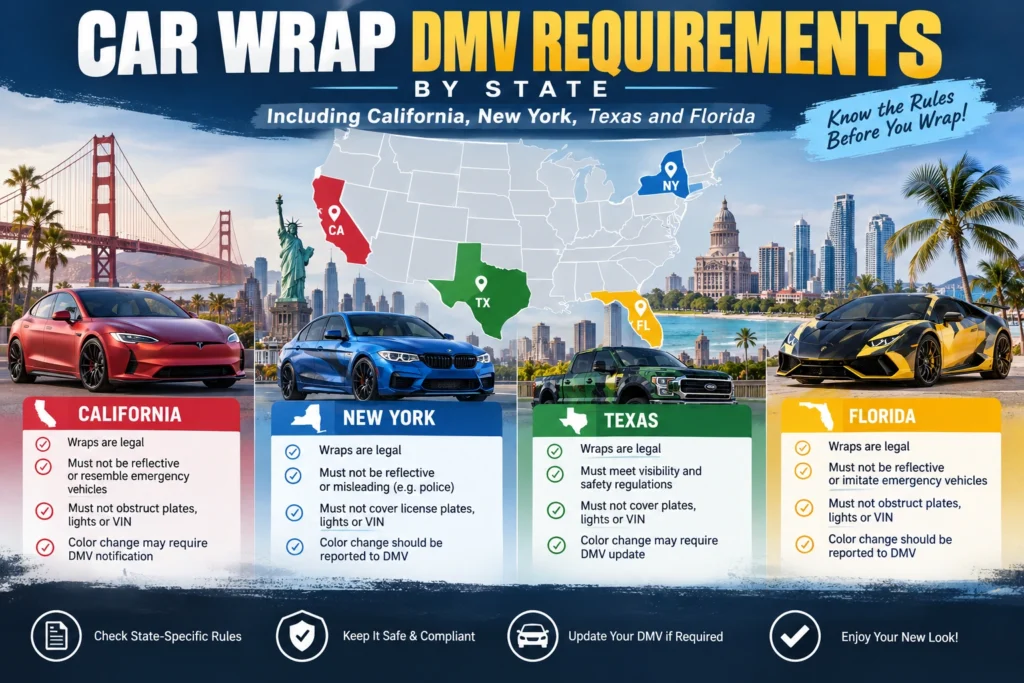
Car Wrap & DMV Requirements by State
| State | What current official material shows | Practical takeaway |
| California | California DMV Form REG 343, the current Application for Title or Registration, does not list vehicle color in its vehicle-information section. California DMV public registration-update guidance also does not publish a dedicated color-change procedure. | For an ordinary passenger-car vinyl color change, California’s published consumer forms do not show a standard color-update requirement. If your situation is unusual, confirm with CA DMV before relying on that absence. |
| New York | New York DMV Form MV-82 includes a “Color” field in the vehicle description. NY DMV says MV-82 can be used to register, renew, change a registration, replace an item, transfer plates or get a title. Its public “Change Information” page does not currently provide a specific color-change section. | Because New York records color, a full color-change wrap deserves a direct check with NY DMV or a local office. Do not assume that the lack of a dedicated web instruction means color is irrelevant. |
| Texas | The TxDMV Motor Vehicle Registration Manual says vehicle color is not required to be entered in the system, although capturing color can help law enforcement identify a vehicle. | Texas treats color as non-required registration-system information in the cited manual. A cosmetic wrap normally does not change the core registration identifiers, but contact the county tax office if you want a record confirmed or corrected. |
| Florida | Florida Form HSMV 82040 MV, Application for Certificate of Motor Vehicle Title, includes “Color” in the motor-vehicle description. | Florida records color during titling. If a full wrap changes the predominant color, contact FLHSMV or your local tax collector/license-plate agency for the current process rather than assuming no update is needed. |
California: If I Wrap My Car, Do I Have to Notify DMV?
For California, the strongest current public-document signal is that the DMV’s Application for Title or Registration (REG 343) does not include a vehicle-color field in the vehicle-information section. California’s general public registration guidance also focuses on matters such as ownership, address, title status and registration requirements rather than publishing a standard passenger-vehicle color-change procedure.
That makes California different from states whose title/registration application explicitly asks for vehicle color. Based on the current public forms reviewed for this update, there is no obvious standard California DMV form telling passenger-car owners to report a vinyl wrap solely because it changes exterior color.
Still, unusual cases can justify confirming directly with DMV — for example, commercial registration, reconstructed vehicles, law-enforcement identification concerns, or a modification that goes beyond cosmetic vinyl.
New York: If I Wrap My Car, Do I Have to Notify DMV?
New York deserves more caution. The current NY DMV Vehicle Registration/Title Application (MV-82) asks for the vehicle’s color in the vehicle-description section. That means color is information New York collects when processing registration/title activity.
At the same time, NY DMV’s public “Change Information on Vehicle Registration and Title” page does not currently list a specific stand-alone procedure for changing vehicle color. Because the state does record color, owners making a full, predominant color change should verify the current procedure with NY DMV rather than relying on a generic internet answer.
Texas: Does a Wrap Color Change Need to Be Reported?
Texas provides a useful contrast. The TxDMV Motor Vehicle Registration Manual states that vehicle color is not required to be entered in the registration system, although the information can assist law enforcement with vehicle identification. That makes a cosmetic wrap less likely to affect required registration data than in a state where color is a mandatory vehicle-description field.
If you want confirmation for a specific vehicle record, TxDMV directs many registration matters through county tax offices, so the local county office is the appropriate place to verify an unusual case.
Florida: Check Before Assuming a Full Color Change Needs No Update
Florida’s current motor-vehicle title application (HSMV 82040 MV) includes “Color” as part of the vehicle description. That shows color is part of the state’s titling data. The form itself does not establish that every vinyl wrap triggers a new title or registration transaction, so a full wrap from one predominant color to another should be checked with FLHSMV or the local tax collector/license-plate agency.
What About Other U.S. States?
For states not listed above, use the same verification method rather than relying on a national rule. Search your state motor-vehicle agency for its current title/registration application and for pages called “change registration information,” “correct title,” “vehicle description,” or similar. If color is collected but the update procedure is unclear, contact the agency directly.
- Use the official state DMV/MVA/BMV/DOR website, not only wrap-shop blogs or forum posts.
- Check the newest form revision date. Old forms can remain indexed in Google.
- Ask specifically about a “predominant exterior color change caused by a removable vinyl wrap.”
- Keep a screenshot or written response if an agency gives you instructions that are not published online.
- If the vehicle is leased, financed, commercial, fleet-owned or company-branded, also check your contract or fleet policy.
Full Wrap vs Partial Wrap: Why the Difference Matters
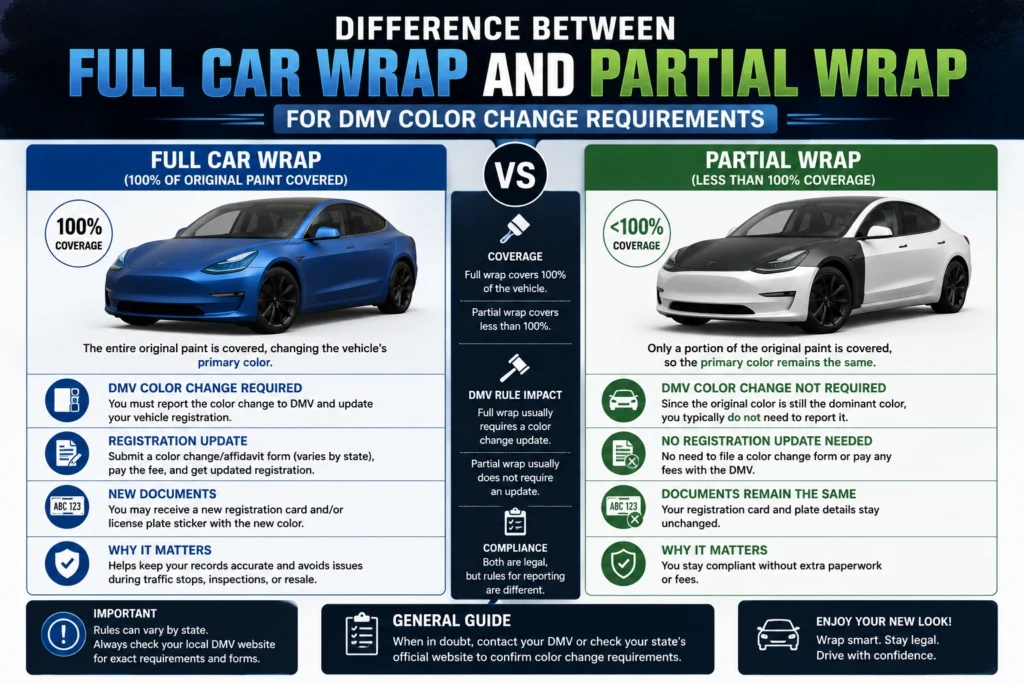
A full-body wrap can make the car appear to be a completely different color. A partial wrap may not. If your state records color, the most defensible way to describe the car is usually its predominant visible exterior color, but each state can define or apply its records differently.
If you are comparing different wrap options, you can also learn more about how much does it cost to wrap a car before choosing between a full wrap and a partial wrap
| Modification | Does it usually change predominant visible color? | DMV-check priority |
| Clear PPF / transparent protection | No | Low |
| Roof-only wrap | Usually no | Low |
| Racing stripes / accents | No | Low |
| Door or hood wrap only | Usually no | Low to medium |
| Commercial graphics over original paint | Depends on coverage | Medium |
| Full-body color-change wrap | Yes | High |
| Full printed advertising wrap | Often yes | High |
What If the Wrap Is Temporary?
Vinyl is removable, but “temporary” can still mean several years. A state that requires accurate descriptive information may care more about what the vehicle looks like during normal use than whether the change can eventually be reversed. Do not assume removability automatically eliminates an administrative requirement.
If you are deciding between a removable vinyl wrap and a permanent paint change, our car wrap vs paint guide explains the differences in cost, durability, customization, and long-term considerations.
Do I Need to Tell My Insurance Company About a Car Wrap?
DMV notification and insurance disclosure are separate issues. Even if your state does not require a color update, your insurer may want to know about a modification or may need the wrap declared if you expect the policy to cover its replacement value after a loss.
A basic color-change wrap and an expensive custom printed wrap can have very different replacement costs. Contact the insurer before installation if coverage of the wrap itself matters to you. Vinyl Wrap Pro has a separate guide explaining whether you need to tell your insurance company about a car wrap, so this page should link there rather than duplicating that topic in depth.
What About Leased or Financed Cars?
A DMV may have no issue with the wrap while your lease or finance agreement imposes separate conditions. Check for clauses covering vehicle modifications, appearance, removal before return, paint damage and residual-value charges. Keep the original paint in good condition and use an installer experienced with leased vehicles if the wrap must later be removed.
What About Commercial Vehicle Wraps?
Commercial graphics can create additional rules unrelated to basic registration color. Depending on the business and jurisdiction, advertising, DOT identification, fleet markings, permits or commercial-registration requirements can apply. A company vehicle should therefore be checked for both vehicle-registration requirements and business/fleet compliance.
What to Do Before and After a Full Color-Change Wrap
- Before wrapping, check whether your current registration/title documents display a color.
- Open your state motor-vehicle agency’s current registration/title application and see whether color is a recorded field.
- Look for an official procedure to change or correct vehicle-description information.
- If the procedure is unclear, contact the state agency or local registration office and ask about a full vinyl color change.
- Keep your invoice showing the wrap is a removable cosmetic modification.
- · Inform your insurer if your policy requires modification disclosure or if you want the wrap’s value covered.
- If leased or financed, check the contract before installation.
- After removal, check whether any previously updated vehicle-description information should be changed back.
Ready to change your car’s color? Once you have checked your state requirements, compare wrap options and request a local vehicle-wrap quote through Vinyl Wrap Pro.
Car Wrap & DMV FAQs
Not in every state. Some states record vehicle color and others do not treat it as required registration data. Check the motor-vehicle agency for the state where your car is registered, especially for a full-body color change.
It depends on the state. A full wrap that changes the predominant exterior color is more likely to raise a registration-record question than a roof wrap, stripe or clear PPF. Use your state’s official forms and guidance.
A wrap does not create one universal U.S. reporting rule. The answer depends on what your state records and whether it publishes a color-change procedure.
Possibly, if your state records vehicle color and requires that descriptive information to remain current. If the official website is unclear, ask the DMV/MVA/BMV directly before or immediately after a full color change.
California DMV’s current REG 343 title/registration application does not list vehicle color in the vehicle-information section, and the public guidance reviewed for this update does not show a standard passenger-car color-change process. For unusual cases, confirm directly with CA DMV.
New York DMV’s MV-82 registration/title application includes a color field. Because New York records color but its public change-information page does not currently give a dedicated wrap/color-change procedure, a full color-change wrap should be verified with NY DMV.
A normal vinyl wrap does not change ownership, VIN or the underlying identity of the vehicle. Whether the vehicle-description data should be updated is a separate state-specific question.
Clear PPF normally does not change the vehicle’s visible color, so it is different from a full color-change wrap. State rules still control, but the color-record issue is generally much less relevant.
If you previously updated a state record because the wrap changed the car’s predominant color, check whether the record should be changed back after removal.
Vehicle color can be used as descriptive information by law enforcement, but enforcement practices and registration rules vary. Keeping state records accurate where required avoids unnecessary confusion.
Bottom Line
If you are asking “if I wrap my car, do I have to notify DMV?”, the correct 2026 answer is not a universal yes or no. Check the state where the vehicle is registered. California’s current registration application does not list color; New York and Florida applications do; Texas says color is not required in its registration system. A full-body color change deserves more attention than a partial wrap or clear PPF.
The strongest approach is simple: verify the official state form, check the agency’s change-information guidance, and contact the agency when the rule is not explicit. That gives you a much safer answer than relying on a general wrap-shop claim.